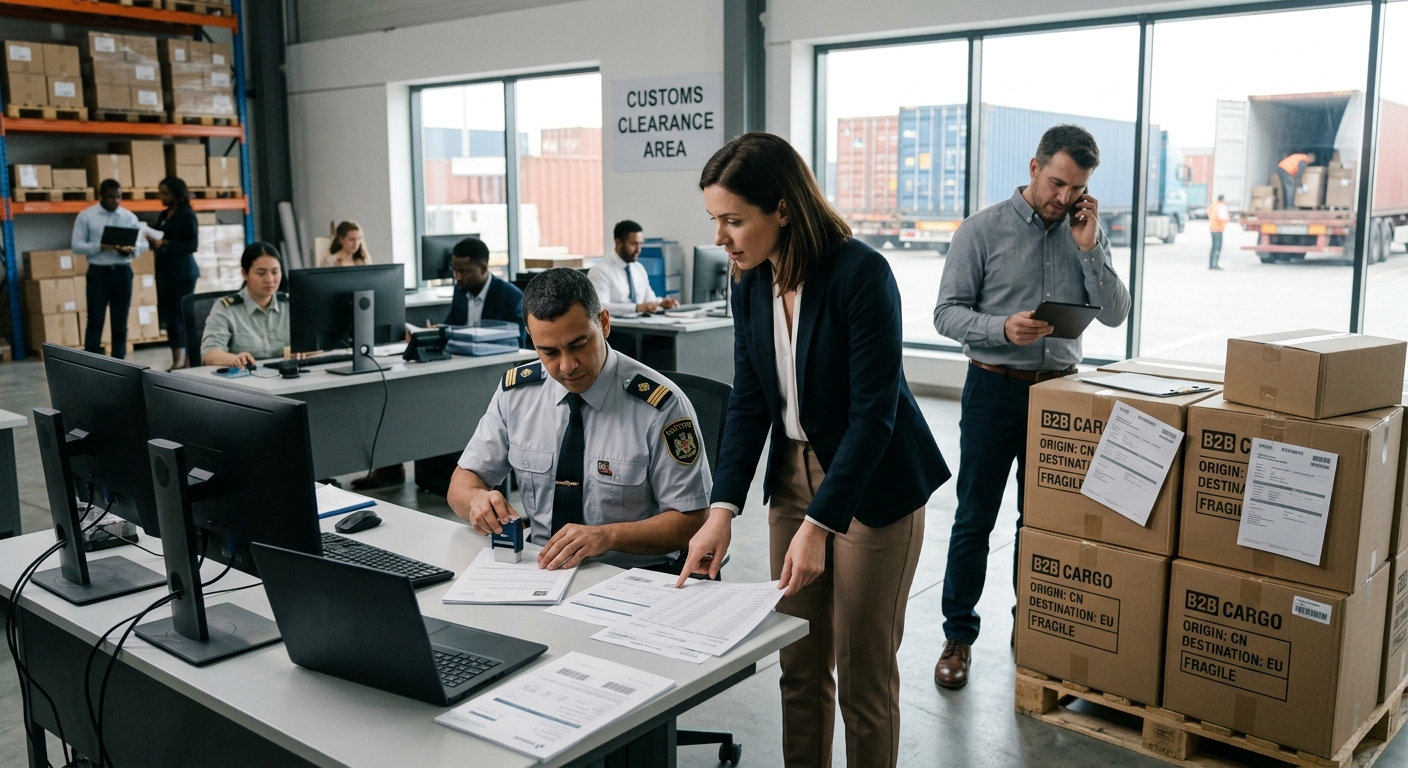
Introduction to B2B Customs Clearance
Navigating the global marketplace requires a deep understanding of international trade regulations. For businesses engaged in cross-border transactions, the B2B customs clearance process is an unavoidable and crucial step. Customs clearance involves the preparation and submission of documentation required to facilitate the export or import of goods into a country, representing the client during customs examination, assessment, payment of duty, and taking delivery of cargo from customs after clearance along with documents. Understanding this process is vital to avoiding costly delays, legal issues, and disrupted supply chains.
Unlike business-to-consumer (B2C) shipments, which often involve smaller quantities and lower values, B2B shipments are typically bulk orders, high-value machinery, or large-scale raw materials. The stakes are considerably higher, and customs authorities scrutinize these shipments rigorously to ensure compliance with local and international laws, proper taxation, and safety standards.
The Core Stages of B2B Customs Clearance
The customs clearance process can seem labyrinthine, but it generally follows a standard sequence of events regardless of the destination country. Knowing these steps helps logistics managers and business owners anticipate requirements and streamline their operations.
1. Document Preparation and Submission
Before goods even reach the border, the exporting and importing businesses must prepare a comprehensive set of documents. These documents serve as the foundation for the customs declaration. The accuracy of this paperwork is non-negotiable; even a minor typo can result in shipments being held at the border for weeks. During this phase, it is highly recommended to consult The Ultimate Guide to International B2B Shipping Logistics to ensure your overall shipping strategy aligns with customs expectations.
2. Customs Assessment
Once the goods arrive at the port of entry, customs officials review the submitted paperwork. They check if the documentation is complete and matches the physical cargo. The customs officer will look at the commercial invoice, the packing list, the bill of lading, and any required certificates of origin or licenses. If everything is in order, the process moves to the next phase. If discrepancies are found, the goods may be flagged for physical inspection.
3. Calculation of Duties and Taxes
Every country levies different taxes and duties on imported goods, which are determined by the Harmonized System (HS) code assigned to the product. The customs broker or the customs authority will calculate the exact amount owed based on the shipment's declared value, its origin, and its classification. Establishing clear incoterms during initial negotiations can dictate who is responsible for these fees. For insights on setting favorable terms, read How to Negotiate International B2B Deals Successfully.
4. Payment and Release of Goods
After the duties and taxes are calculated, they must be paid before the goods can be released. Depending on the agreed-upon incoterms (such as DDP or EXW), either the buyer or the seller will handle this payment. Many businesses use customs brokers who have deferment accounts to expedite this process. Once payment is confirmed, customs releases the shipment, and it can continue its journey to the final destination.
Essential Documents for B2B Customs Clearance
Documentation is the lifeblood of international trade. Without the correct paperwork, the customs clearance process comes to a grinding halt. Below is a table outlining the most critical documents required for B2B shipments.
| Document Name | Description | Responsible Party |
|---|---|---|
| Commercial Invoice | A legal document between the supplier and the buyer detailing the goods, quantity, and value. | Exporter / Seller |
| Bill of Lading (B/L) | A contract between the owner of the goods and the carrier detailing the type, quantity, and destination of the goods. | Carrier / Freight Forwarder |
| Packing List | A detailed list specifying the contents of each package, weight, and dimensions. | Exporter / Seller |
| Certificate of Origin | A document certifying the country in which the goods were manufactured or produced. | Exporter (often certified by a Chamber of Commerce) |
| Customs Bond | A contract used in the US (and similar concepts elsewhere) ensuring payment of duties and taxes. | Importer / Buyer |
Regional Complexities in Customs Clearance
While the fundamental steps of customs clearance remain consistent globally, individual countries have their own unique regulations, restricted items lists, and bureaucratic nuances. For instance, exporting to or importing from Southeast Asia involves navigating a distinct set of regional trade agreements and local customs practices. If your business operations involve the Indonesian market, you will find valuable, region-specific information in Navigating the Customs Clearance Process for Indonesian Exports: A Comprehensive Guide. Understanding these localized rules is crucial for preventing unexpected demurrage charges and ensuring a smooth supply chain.
Best Practices for a Smooth Clearance Process
To avoid the pitfalls commonly associated with B2B customs clearance, businesses should adopt several best practices:
- Hire a Licensed Customs Broker: Customs brokers are licensed professionals who specialize in clearing goods through customs. They stay updated on the latest regulations and can handle the complex paperwork on your behalf.
- Classify Goods Correctly: Ensure your products are assigned the correct HS (Harmonized System) codes. Incorrect classification can lead to overpaying duties or facing severe penalties for underpayment.
- Maintain Transparent Valuation: Always declare the true value of your goods. Customs authorities have sophisticated methods for detecting under-valuation, which is a form of fraud.
- Double-Check Paperwork: Ensure that the information across all documents (commercial invoice, packing list, bill of lading) matches perfectly. Discrepancies are a primary trigger for customs audits and delays.
Conclusion
The B2B customs clearance process is a complex but manageable aspect of international trade. By understanding the required documentation, the stages of assessment, the calculation of duties, and the importance of accurate product classification, businesses can mitigate risks and ensure their supply chains operate efficiently. Investing time in compliance and partnering with experienced freight forwarders and customs brokers is not just a regulatory necessity; it is a strategic business advantage in the competitive global marketplace.
Frequently Asked Questions (FAQ)
What is the difference between B2B and B2C customs clearance?
B2B customs clearance generally involves higher value shipments, larger volumes, and more complex documentation compared to B2C. B2B shipments often require specific import licenses, commercial invoices, and strict HS code classification, whereas B2C shipments are often lower in value and can sometimes pass through customs more quickly under de minimis thresholds.
How long does the customs clearance process take?
The timeframe can vary significantly. If all documentation is perfectly in order and there are no physical inspections, clearance can happen in a matter of hours or days. However, if paperwork is missing, if the goods are selected for physical examination, or if there are disputes over valuation, the process can take several weeks.
What are HS codes and why are they important?
Harmonized System (HS) codes are an internationally standardized system of names and numbers used to classify traded products. They are critically important because customs authorities use them to determine the specific tariffs, duties, and taxes applicable to a product, as well as to track trade statistics and enforce quotas or restrictions.
Who is responsible for paying customs duties?
The responsibility for paying customs duties depends entirely on the Incoterms (International Commercial Terms) agreed upon by the buyer and seller in their contract. For example, under DDP (Delivered Duty Paid), the seller is responsible for all duties and taxes. Under EXW (Ex Works) or FOB (Free On Board), the buyer typically assumes responsibility for import clearance and duties.
Comments
Post a Comment