Introduction to Incoterms
In the complex world of international trade, understanding the distinct responsibilities of buyers and sellers is paramount. The International Chamber of Commerce (ICC) established Incoterms (International Commercial Terms) to standardize these rules, providing a universal language for global commerce. Among the most frequently used Incoterms are Free On Board (FOB) and Ex Works (EXW). Knowing the differences between FOB and EXW terms is critical for managing costs, determining liability, and ensuring smooth supply chain operations.
What is EXW (Ex Works)?
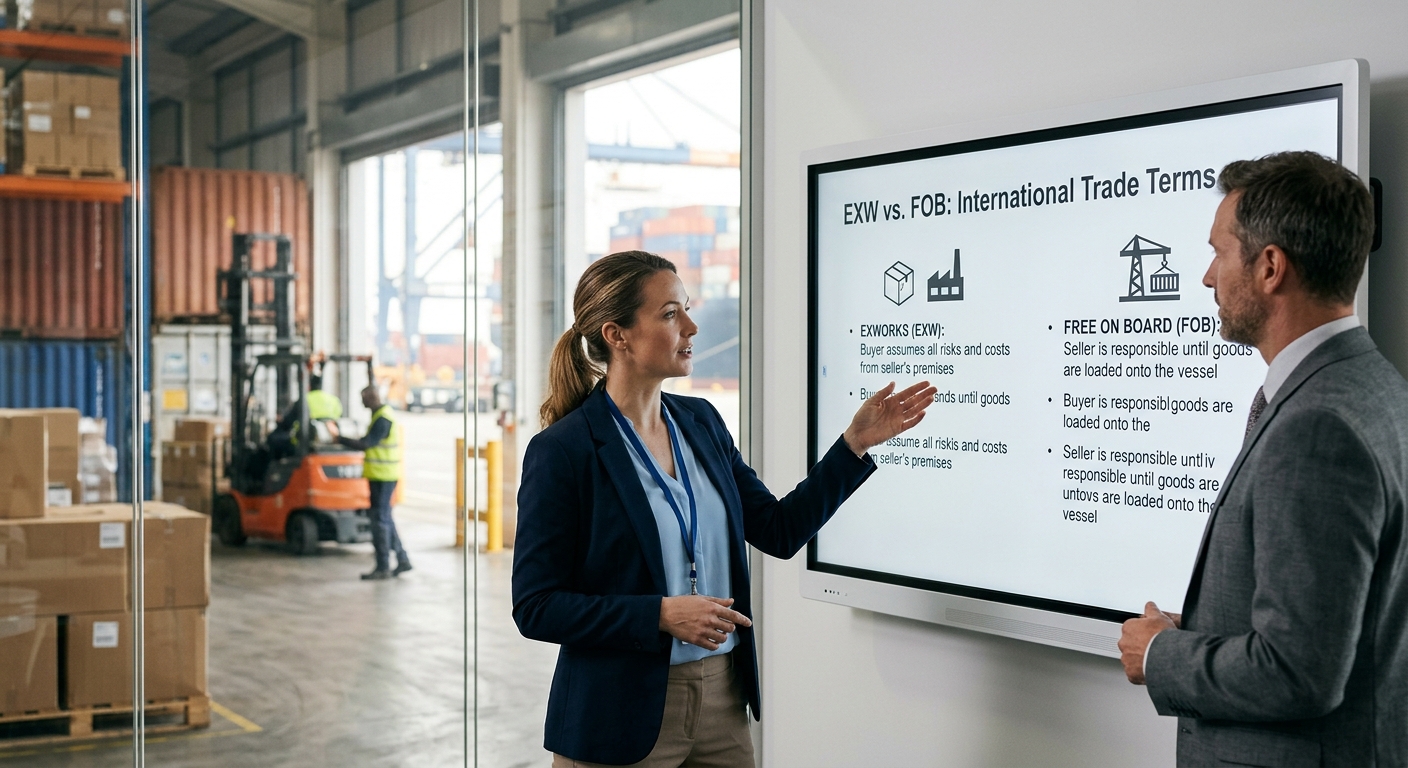
Ex Works (EXW) represents the minimum obligation for the seller. Under EXW terms, the seller's only responsibility is to make the goods available at their premises (such as a factory, warehouse, or depot) securely packaged and ready for collection. Once the goods are made available, the buyer assumes all risks and costs associated with transporting the goods to their final destination.
This means the buyer is responsible for loading the goods onto the initial transport vehicle, arranging export customs clearance, handling international freight, and covering all import duties and taxes. While EXW offers the buyer maximum control over the shipping process and visibility into logistics costs, it also requires a deep understanding of international shipping and the ability to manage complex supply chains effectively.
What is FOB (Free On Board)?
Free On Board (FOB) is an Incoterm specifically designed for sea or inland waterway transport. Under FOB terms, the seller is responsible for all costs and risks until the goods are loaded onto the vessel nominated by the buyer at the named port of shipment. The seller handles domestic transport, export customs clearance, and port handling charges up to the point of loading.
Once the goods are safely stowed on the vessel, the risk and responsibility shift to the buyer. The buyer must then manage the main carriage freight, marine insurance, unloading at the destination port, import clearance, and final delivery. FOB is widely preferred in international trade because it offers a balanced distribution of risk and responsibility, allowing sellers to handle local logistics while giving buyers control over international sea freight.
The Role of Clear Contracts
Regardless of the Incoterm chosen, outlining the specifics in a legally binding agreement is essential. To ensure all terms are properly documented and understood by both parties, you should consult a Comprehensive Guide to Drafting International B2B Trade Contracts. This will help you avoid costly disputes regarding costs, risks, and responsibilities.
Key Differences Between FOB and EXW Terms
The primary differences between FOB and EXW revolve around the transfer of risk, allocation of costs, and the responsibility for export clearance. To make an informed decision, businesses must carefully evaluate their logistical capabilities and risk tolerance.
Transfer of Risk and Responsibility
Under EXW, the risk transfers from the seller to the buyer the moment the goods are made available at the seller's facility. The buyer is responsible for loading the cargo, which can be risky if the buyer's logistics provider is unfamiliar with the seller's premises. Conversely, under FOB, the risk transfers only after the goods are loaded onto the ship. This means the seller bears the risk of loss or damage during domestic transit and the loading process.
Export Customs Clearance
Export customs clearance is a significant differentiator. With EXW, the buyer is entirely responsible for clearing the goods for export. This can be highly challenging if the buyer lacks a local presence or knowledge of the exporting country's regulations. In some countries, only locally registered companies can process exports, forcing buyers to hire third-party agents. When learning How to Verify Overseas Business Licenses: A Comprehensive Guide, you will realize the complexities involved in foreign regulations. In contrast, FOB requires the seller to handle all export customs formalities, leveraging their local knowledge and legal status to ensure smooth clearance.
Cost Allocation
Cost allocation aligns with the transfer of responsibility. An EXW price is typically the lowest unit price offered by a seller because it excludes transport and export costs. However, the buyer must account for all subsequent logistics expenses. An FOB price is inherently higher as it includes domestic transportation, terminal handling charges, and export clearance fees. Buyers often find FOB easier to budget for, as it eliminates the unpredictable costs of origin-country logistics.
To clearly illustrate how these two popular Incoterms distribute responsibilities, review the comparison table below.
| Responsibility | EXW (Ex Works) | FOB (Free On Board) |
|---|---|---|
| Loading at Seller's Facility | Buyer | Seller |
| Domestic Transport to Port | Buyer | Seller |
| Export Customs Clearance | Buyer | Seller |
| Loading onto Vessel | Buyer | Seller |
| Main Carriage (Ocean Freight) | Buyer | Buyer |
| Import Customs Clearance | Buyer | Buyer |
Choosing the Right Incoterm for Your Business
Selecting between EXW and FOB depends largely on your experience with international logistics and your relationship with suppliers. EXW is often chosen by large multinational corporations that have established global logistics networks and prefer to consolidate shipments from multiple suppliers at a single origin warehouse.
However, for most small to medium-sized enterprises (SMEs) importing goods via ocean freight, FOB is generally the recommended choice. FOB prevents the buyer from having to navigate complex foreign export regulations and local transport issues. For businesses looking to optimize their supply chains, consulting a reliable global B2B network can provide valuable insights into selecting the best shipping terms and finding capable freight forwarders.
Conclusion
Understanding the differences between FOB and EXW terms is fundamental to successful international trade. While EXW provides the lowest initial product cost and maximum buyer control over logistics, it carries significant risks and responsibilities, particularly regarding export clearance. FOB, on the other hand, offers a balanced approach, placing origin logistics and export clearance in the capable hands of the seller while allowing the buyer to control the main ocean freight. By carefully analyzing your company's logistical capabilities and consulting with experienced freight professionals, you can select the Incoterm that best protects your interests and profit margins.
Frequently Asked Questions
What does EXW stand for?
EXW stands for Ex Works. It is an Incoterm where the seller's only responsibility is to make the goods available at their premises, and the buyer assumes all costs and risks from that point forward.
Can FOB be used for air freight?
According to ICC rules, FOB is specifically intended for sea and inland waterway transport. For air freight, the equivalent Incoterm recommended by the ICC is FCA (Free Carrier).
Which term is better for a new importer, EXW or FOB?
For a new importer, FOB is generally better. It places the responsibility of local transport and export customs clearance on the seller, who is more familiar with their local laws and logistics networks, reducing the risk of costly errors for the buyer.
Comments
Post a Comment